Multiprocessing on GPU#
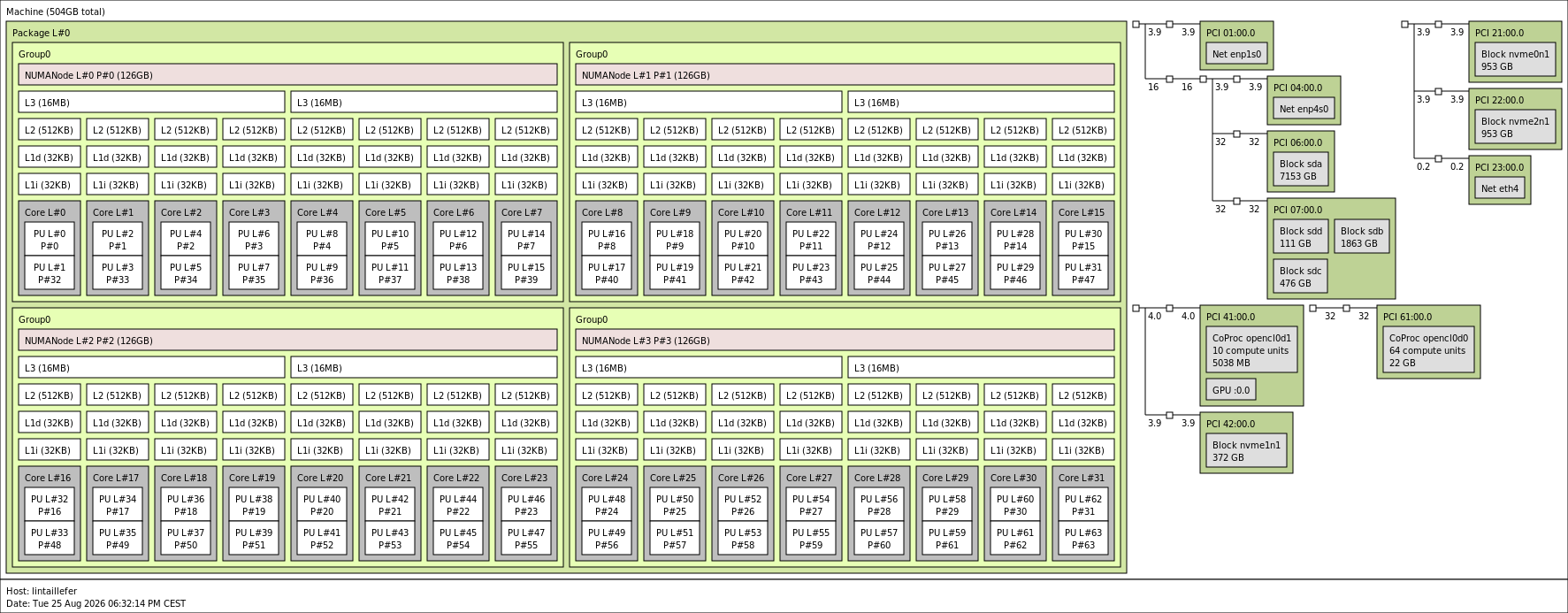
In this tutorial, the idea is to parallelize the reading of several HDF5 files across different processes and to perform the azimuthal integration on the GPU together with Bitshuffle-LZ4 decompression. The scale of this problem involves 1000 files containing 1000 frames each of 4Mpx resolution—that’s one million frames total. The reduced data will be 1000×1000×1000 in single-precision float format. This is an extreme case where we’ll explore how to utilize all available computer resources. The first step is to determine the system topology:
Lenovo P620 Workstation
1 processor: AMD Threadripper PRO 3975WX, 32 cores with hyperthreading (64 threads) across 4 NUMA sub-domains. 450W TDP.
2 GPUs:
NVIDIA RTX A5000 (8192 CUDA-cores, 24 GB GDDR6, 16xPCIe4, 230W)
NVIDIA Quadro P2200 (1280 CUDA-cores, 5GB GDDR5, 16xPCIe3, 75W)
Disclaimer:
We use the
multiprocesslibrary instead ofmultiprocessingto demonstrate this procedure within a Jupyter notebook.We use
SharedArrayto provide a natural way of sharing the result array in memory between processes.
%matplotlib inline
# use `widget` for better user experience; `inline` is for documentation generation

#Topology of the computer:
!lstopo /tmp/topo.png
from IPython.display import Image
Image(filename='/tmp/topo.png')
Exporting format `png' to file `/tmp/topo.png'
Failed to open /tmp/topo.png for writing (File exists)
import os
import glob
import time
import json
from matplotlib.pyplot import subplots
import multiprocess
from multiprocess import Process
if "mpctx" in globals():
    mpctx = multiprocess.get_context('spawn')
else:
    multiprocess.set_start_method('spawn')
    mpctx = multiprocess.get_context('spawn')
import numpy
import hdf5plugin
import h5py
import pyFAI
import SharedArray
from silx.opencl import ocl
from silx.opencl.codec.bitshuffle_lz4 import BitshuffleLz4
import collections
# import bitshuffle_lz4
Item = collections.namedtuple("Item", "index filename")
MAIN_PROCESS = multiprocess.parent_process() is None
print("pyFAI version: ", pyFAI.version)
print(ocl)
pyFAI version:  2026.9.0
OpenCL devices:
[0] NVIDIA CUDA: (0,0) NVIDIA RTX A5000, (0,1) Quadro P2200
[1] Portable Computing Language: (1,0) cpu-haswell-AMD Ryzen Threadripper PRO 3975WX 32-Cores
[2] Intel(R) OpenCL: (2,0) AMD Ryzen Threadripper PRO 3975WX 32-Cores
#This cell contains the parameters for all the processing
params = {
    "DEVICES": [[0,0], [0,0], [0,0], [0,0], [0,0], [0,0],   # 6 instances on the large GPU
                [0,1], [0,1], [0,1],                        # 3 instances on the small GPU
                [2,0]],                                     # 1 instance on the CPU-cores
    "NWORKERS": 10,
    "FRAME_PER_FILE": 1000,
    "NFILES" : 1000,
    "NBINS" : 1000,
    "DETECTOR":"Eiger_4M",
    "pathname" : "/tmp/big_%04d.h5",
    "pathmask" : "/tmp/big_????.h5",
    "dtype" : "float32",
    "SHARED_NAME" : "shm://multigpu",
    "array_shape" : [1000, 1000, 1000],
    }
with open("param.json", "w") as w: w.write(json.dumps(params, indent=2))
for k,v in params.items():
    globals()[k] = v
def build_integrator(detector=DETECTOR):
    "Build an azimuthal integrator with a dummy geometry"
    geo = {"detector": detector,
           "wavelength": 1e-10}
    ai = pyFAI.load(geo)
    return ai
# Generate a set of files
def generate_one_frame(ai, unit="q_nm^-1", dtype="uint32"):
    """Prepare a frame with little count so that it compresses well"""
    qmax = ai.array_from_unit(unit=unit).max()
    q = numpy.linspace(0, qmax, 100)
    img = ai.calcfrom1d(q, 100/(1+q*q))
    frame = numpy.random.poisson(img).astype(dtype)
    return frame

def generate_files(img):
    cmp = hdf5plugin.Bitshuffle()
    filename = pathname%0
    shape = img.shape
    with h5py.File(filename, "w") as h:
        ds = h.create_dataset("data", shape=(FRAME_PER_FILE,)+shape, chunks=(1,)+shape, dtype=img.dtype, **cmp)
        for i in range(FRAME_PER_FILE):
            ds[i] = img + i%500 #Each frame has a different value to prevent caching effects
    res = [filename]
    for i in range(1, NFILES):
        new_file = pathname%i
        os.link(filename,new_file)
        res.append(new_file)
    return res

# Create a set of files with dummy data in them:
if len(glob.glob(pathmask)) == NFILES:
    input_files = glob.glob(pathmask)
    input_files.sort()
else:
    for f in glob.glob(pathmask):
        os.remove(f)
    input_files = generate_files(generate_one_frame(build_integrator(DETECTOR)))
input_files[:5]
['/tmp/big_0000.h5',
 '/tmp/big_0001.h5',
 '/tmp/big_0002.h5',
 '/tmp/big_0003.h5',
 '/tmp/big_0004.h5']
#This is allows to create and destroy shared numpy arrays

def create_shared_array(shape, dtype="float32", name=SHARED_NAME):
    if MAIN_PROCESS and name not in [i.name.decode() for i in SharedArray.list()]:
        ary = SharedArray.create(name, shape, dtype=dtype)
    else:
        ary = SharedArray.attach(name)
    return ary

def release_shared(name=SHARED_NAME):
    if MAIN_PROCESS:
        SharedArray.delete(name)

result_array = create_shared_array(array_shape, dtype, SHARED_NAME)
def worker(rank, queue, shm_name, counter):
    """Function representing one worker, used in a pool of worker.

    :param rank: integer, index of the worker.
    :param queue: input queue, expects Item with index and name of the file to process
    :param shm_name: name of the output shared memory to put integrated intensities
    :param counter: decremented when quits
    :return: nothing, used in a process.
    """
    def new_engine(engine, wg):
        "Change workgroup size of an engine"
        return engine.__class__((engine._data, engine._indices, engine._indptr),
                              engine.size, empty=engine.empty, unit=engine.unit,
                              bin_centers=engine.bin_centers, azim_centers = engine.azim_centers,
                              ctx=engine.ctx, block_size=wg)
    #imports:
    import pyFAI
    import numpy
    import SharedArray
    import h5py
    import json
    from silx.opencl.codec.bitshuffle_lz4 import BitshuffleLz4    #load parameters:
    for k,v in json.load(open("param.json")).items():
        globals()[k] = v
    #Start up the integrator:
    ai = pyFAI.load({"detector": DETECTOR,
                     "wavelength": 1e-10,
                     "rot3":0})
    blank = numpy.zeros(ai.detector.shape, dtype="uint32")
    method = ("full", "csr", "opencl", DEVICES[rank%len(DEVICES)])
    res = ai.integrate1d(blank, NBINS, method=method)
    omega = ai.solidAngleArray()
    engine = ai.engines[res.method].engine

    omega_crc = engine.on_device["solidangle"]
    engine = new_engine(engine, 512)

    gpu_decompressor = BitshuffleLz4(2000000, blank.size, dtype=blank.dtype, ctx=engine.ctx)
    gpu_decompressor.block_size = 128
    result_array = SharedArray.attach(SHARED_NAME)
    with counter.get_lock():
        counter.value += 1
    #Worker is ready !
    while True:
        item = queue.get()
        index = item.index
        if index<0:
            with counter.get_lock():
                counter.value -= 1
            return
        with h5py.File(item.filename, "r") as h5:
            ds = h5["data"]
            for i in range(ds.id.get_num_chunks()):
                filter_mask, chunk = ds.id.read_direct_chunk(ds.id.get_chunk_info(i).chunk_offset)
                if filter_mask == 0:
                    # print(f"{rank}: process frame #{i}")
                    dec = gpu_decompressor(chunk)
                    intensity = engine.integrate_ng(dec, solidangle=omega, solidangle_checksum=omega_crc).intensity
                    result_array[index, i,:] = intensity.astype(dtype)
def build_pool(nbprocess, queue, shm_name, counter):
    """Build a pool of processes with workers, and starts them"""
    pool = []
    for i in range(nbprocess):
        process = Process(target=worker, name=f"worker_{i:02d}", args=(i, queue, shm_name, counter))
        process.start()
        pool.append(process)
    while counter.value<nbprocess:
        time.sleep(1)
    return pool

def end_pool(pool, queue):
    """Ends all processes from a pool by sending them a "kill-pill"""
    for process in pool:
        queue.put(Item(-1, None))

# Build the pool of workers
queue = mpctx.Queue()
counter = mpctx.Value("i", 0)
pool = build_pool(NWORKERS, queue, SHARED_NAME, counter)
pool
/users/kieffer/.venv/py313/lib/python3.13/site-packages/pyopencl/cache.py:445: CompilerWarning: Non-empty compiler output encountered. Set the environment variable PYOPENCL_COMPILER_OUTPUT=1 to see more.
  prg.build(options_bytes, [devices[i] for i in to_be_built_indices])
/users/kieffer/.venv/py313/lib/python3.13/site-packages/pyopencl/cache.py:527: CompilerWarning: Non-empty compiler output encountered. Set the environment variable PYOPENCL_COMPILER_OUTPUT=1 to see more.
  _create_built_program_from_source_cached(
/users/kieffer/.venv/py313/lib/python3.13/site-packages/pyopencl/cache.py:531: CompilerWarning: Non-empty compiler output encountered. Set the environment variable PYOPENCL_COMPILER_OUTPUT=1 to see more.
  prg.build(options_bytes, devices)
[<Process name='worker_00' pid=3706339 parent=3706105 started>,
 <Process name='worker_01' pid=3706340 parent=3706105 started>,
 <Process name='worker_02' pid=3706341 parent=3706105 started>,
 <Process name='worker_03' pid=3706342 parent=3706105 started>,
 <Process name='worker_04' pid=3706343 parent=3706105 started>,
 <Process name='worker_05' pid=3706344 parent=3706105 started>,
 <Process name='worker_06' pid=3706345 parent=3706105 started>,
 <Process name='worker_07' pid=3706346 parent=3706105 started>,
 <Process name='worker_08' pid=3706347 parent=3706105 started>,
 <Process name='worker_09' pid=3706348 parent=3706105 started>]
start_time = time.perf_counter()
for idx, fn in enumerate(input_files):
    queue.put(Item(idx, fn))
end_pool(pool, queue)
counter.value
10
while counter.value:
    time.sleep(1)
run_time = time.perf_counter()-start_time
print(f"run-time: {run_time:.1f}s")
run-time: 793.3s
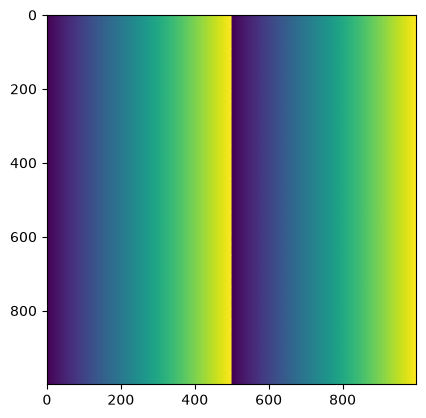
fig, ax = subplots()
ax.imshow(result_array[:,:,5])
<matplotlib.image.AxesImage at 0x7fba085238c0>
print(f"Performances: {NFILES*FRAME_PER_FILE/run_time:.3f} fps")
Performances: 1260.571 fps
release_shared(SHARED_NAME)
Conclusion#
It is possible to achieve 1300 frames per second on a single workstation. In this configuration, one million Eiger-4M frames are processed in 12 minutes.
Energy considerations for processing one million frames:
The workstation consumes 700W at the wall outlet, representing 540 kJ (150 Wh) for the data reduction.
Equivalent processing using only a 6-core workstation takes half a day (40,682 seconds) and consumes 1,561 kJ (433 Wh).
CPU+GPU-based processing is thus approximately 3× more energy-efficient than CPU-only processing.
Other considerations:
Here, disk reading is fast enough, so there’s no need for too many processes per GPU. If disk I/O is slower, adding more processes could be beneficial.
Since the output array resides in shared memory, sufficient RAM must be available to accommodate it. In this case, 512 GB of memory is available.